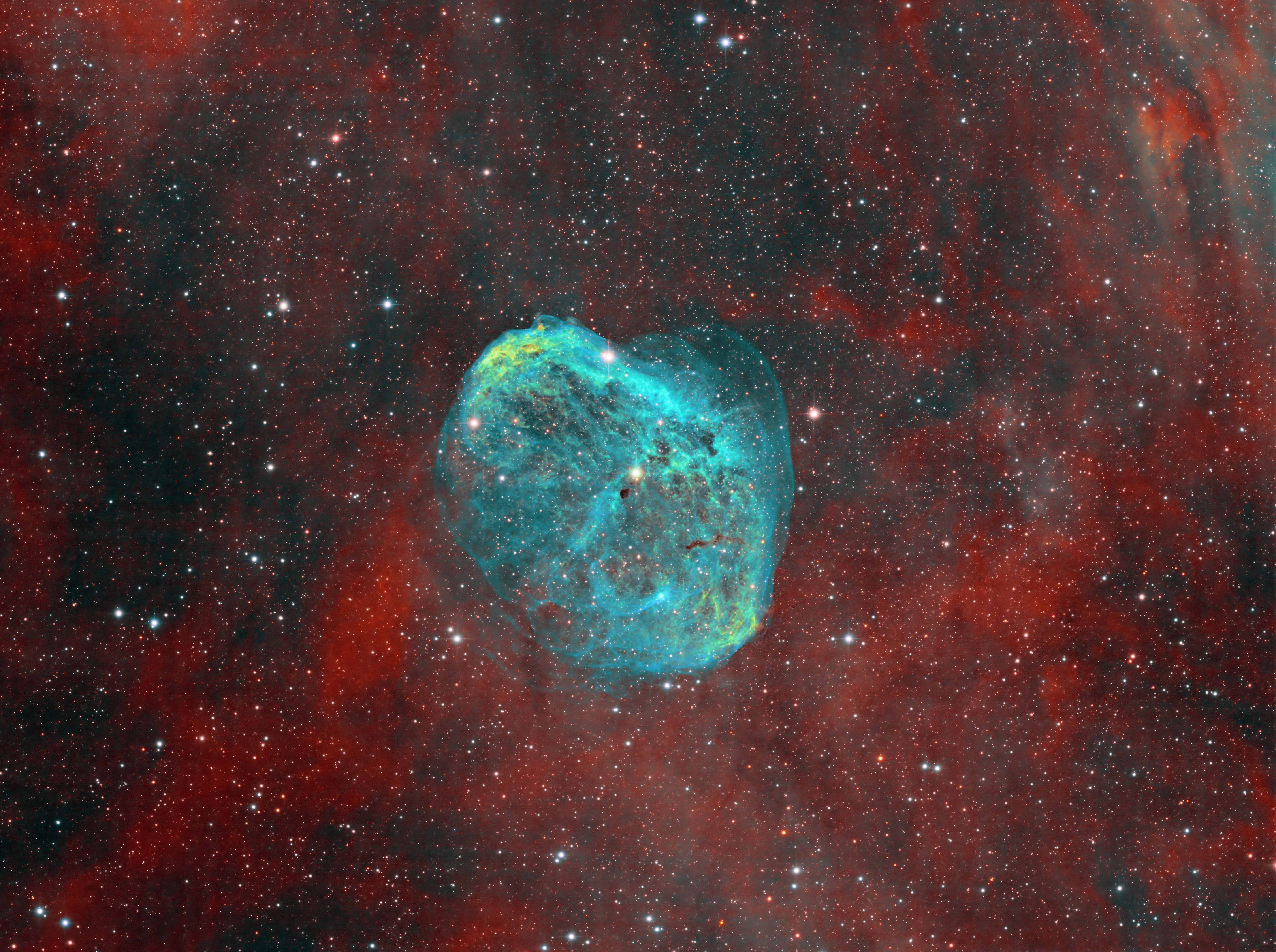
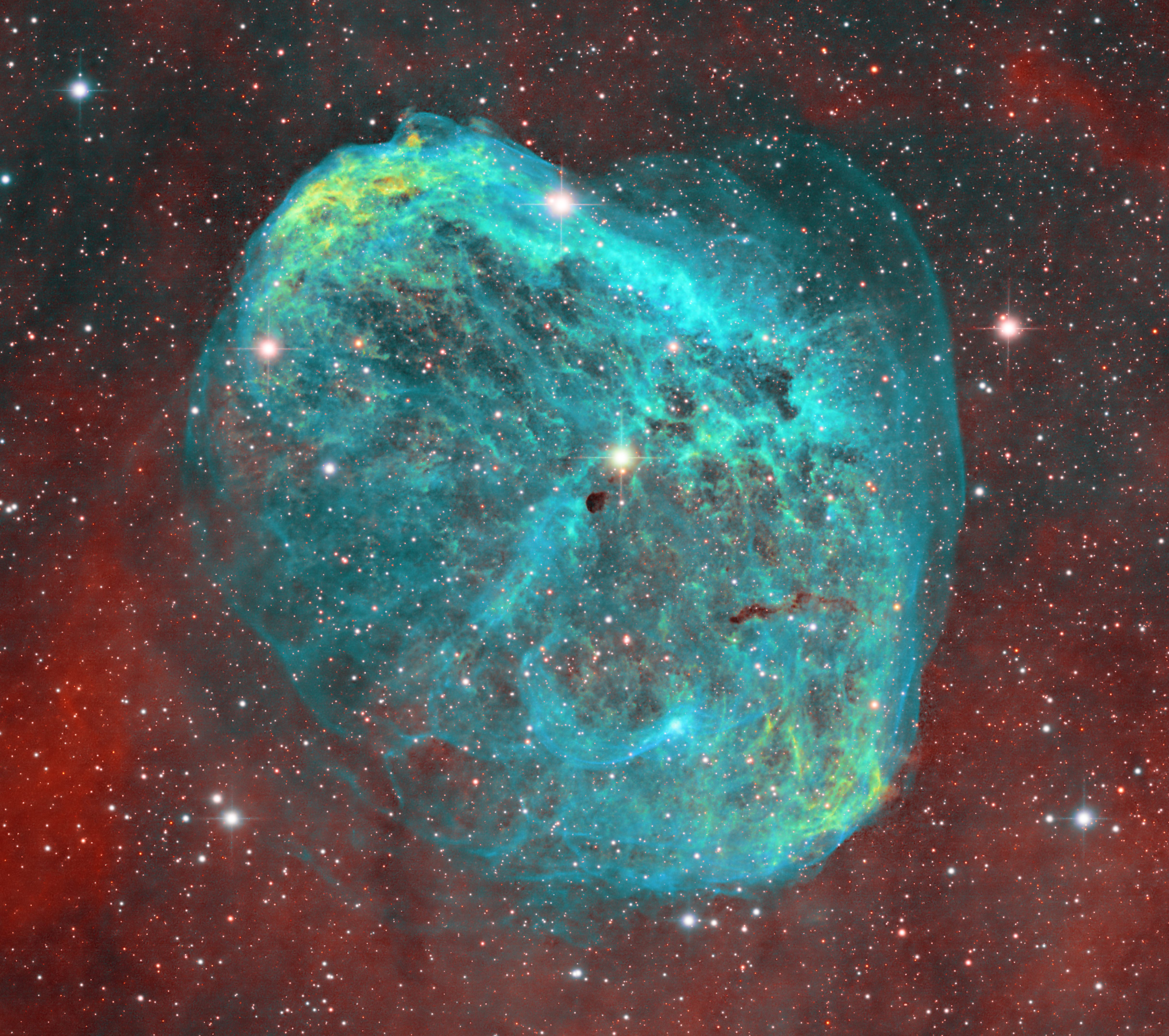
This is the first light on the CDK 14. I offer the data below (free, no string attached, no email collection, Creative Common license), in the spirit of the Moana project. Due to the enormous size of the files, only a stacked version and a sampler of the raw files are provided.
Full definition processed images: RGB and Narrow band.
Raw stacks ready for processing and a sampler of lights coming out of the camera:
Complete pre-stack dataset (fits file straight from the camera) & calibration data are available as S3 buckets, if interested contact me on Astrobin, user blackrig.
Blue 34 x 3mn = 1h42mn, Green 34 x 3mn = 1h42mn, Red 33 x 3mn = 1h39mn, so RGB total integration is 5h02mn.
Ha: 47 x 5mn = 3h55mn, OIII 43 x 5mn = 3h35mn , SII 44 x 5mn =3h 40mn, so total narrow band integration 11h 10mn.
Total integration: 16h 12mn.
This data was taken with gain 2750 for all lights, 3 minutes for color and 5 minutes for narrow band.
After consideration and review of the first light data, for subsequent production I have adjusted gain and integration time: gain 2750 for narrow band with 10 minutes exposure (versus 5mn here), as the NB signal is a bit low on this dataset. RGB frames have been adjusted to gain 0 (to take full advantage of the max well and increase the dynamic) with 3 minutes exposure (unchanged).
On a forward basis, the new gain & exposure settings, plus new calibration files takes care of a very faint banding problem one may see in the low luminance areas of the integrated Crescent image, if stretching the histogram to the extreme.


SHO post stack processing was very basic, all in Pixinsight: Noise X, Blur X, histogram, then combine the frames with my favorite pixel math operator for narrow band: R=(OIII^~OIII)SII + ~(OIII^~OIII)Ha), G=((OIIIHa)^~(OIIIHa))Ha + ~((OIIIHa)^~(OIIIHa))OIII and B=OIII, then magenta removal with pixel math special sauce, saturation adjustment and dark structure enhance, crop.
RGB post stack processing was even more simplistic: RGB combination, Noise X, Blur X, histogram, saturation, crop.