French Special forces in Indochina, October 1945 – January 1948
Page dedicated to Siegmund (Simon) Jezierski – Sergent Chef – Groupment Autonome PONCHARDIER – S.A.S.B.
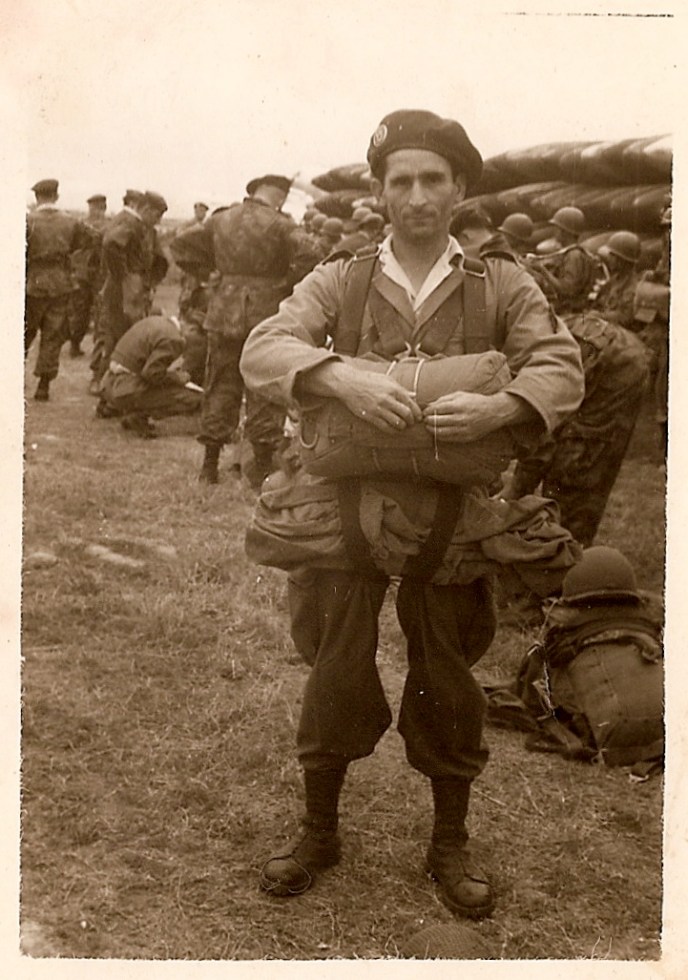
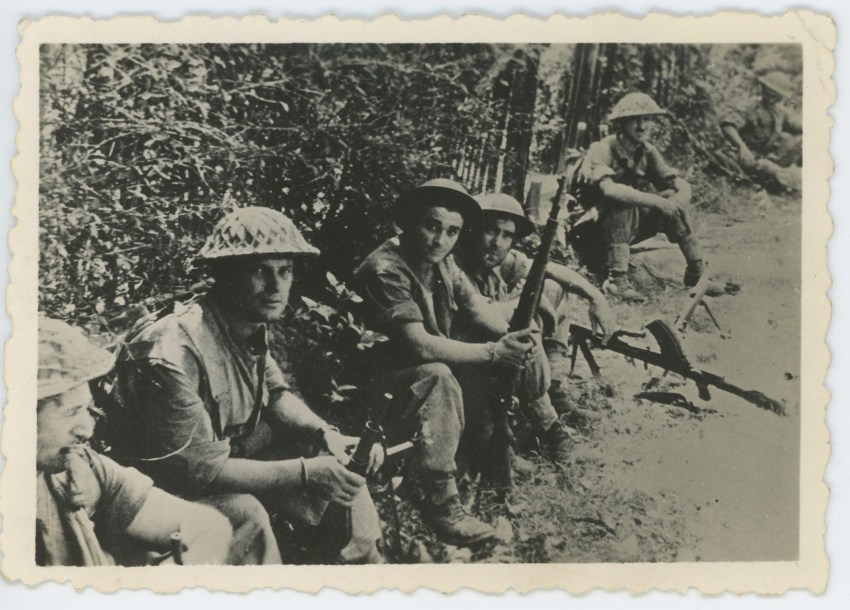

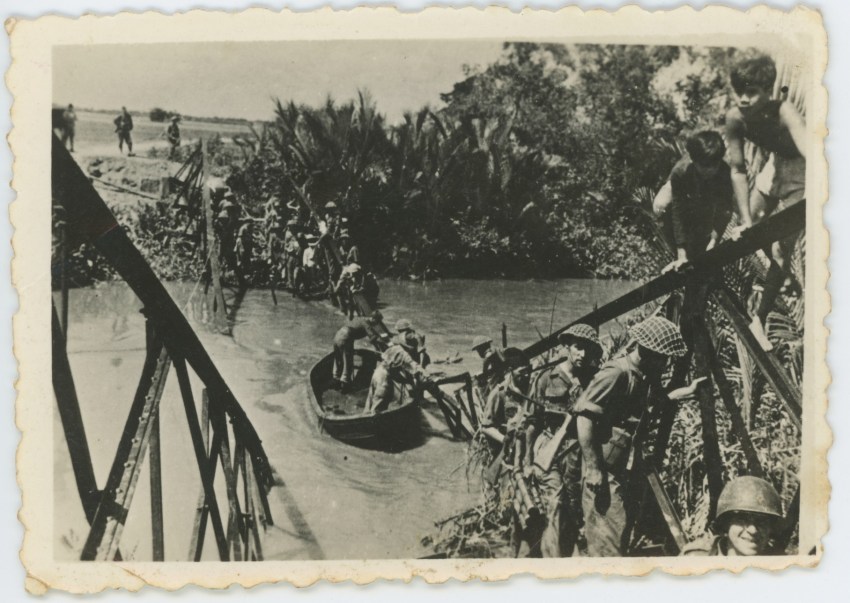
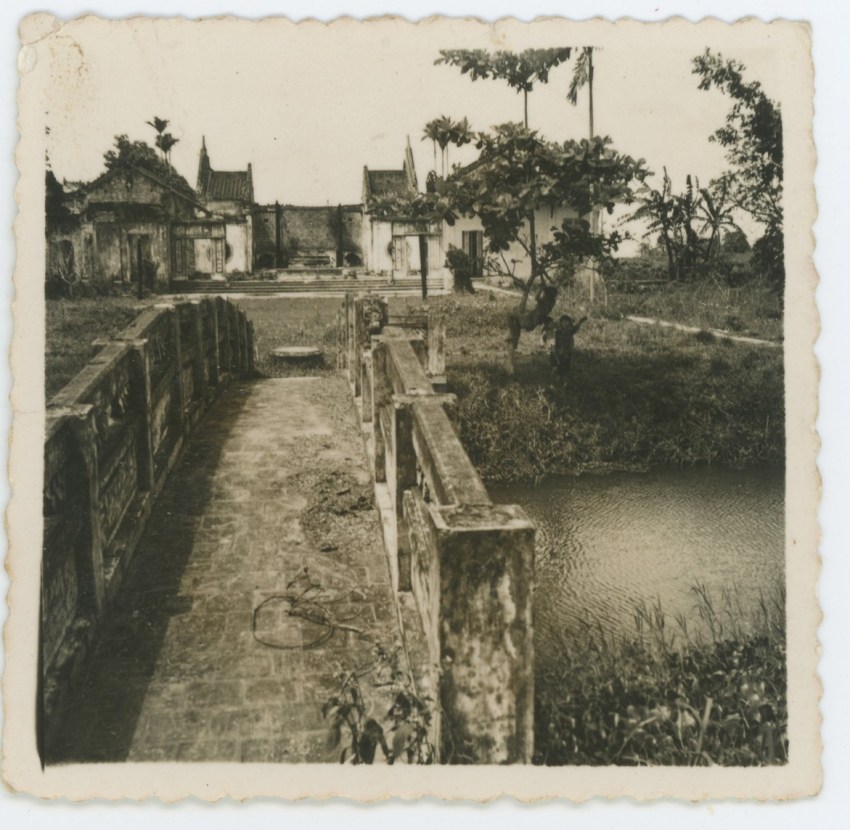
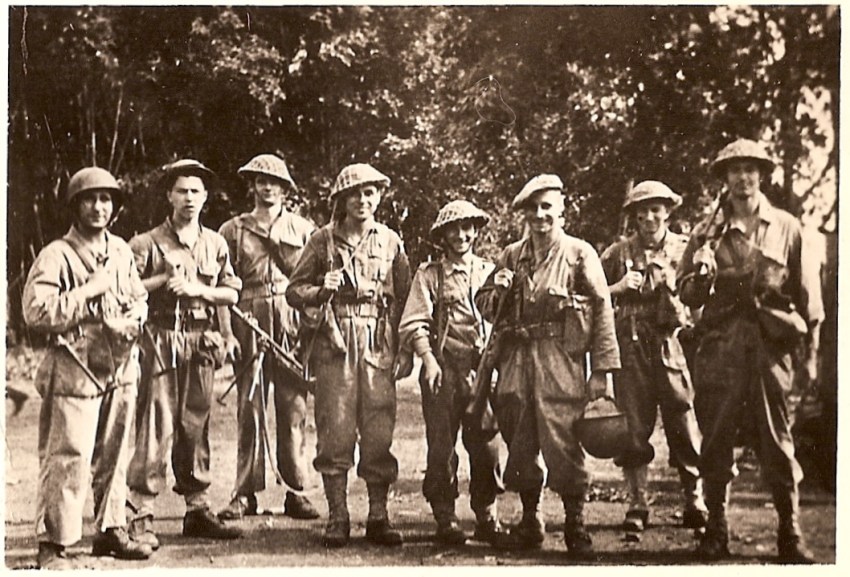
Commando Ponchardier
The unit that Vietnamese fighters called the Cong Cop — the tigers — existed for less than a year in the field. The S.A.S. Bataillon of the 5e R.I.C. was formed at Trincomalee in September 1945 out of two very different bodies of men: colonial infantry of the Corps Léger d’Intervention, trained in India for jungle guerrilla work, and the parachute commando of the Aéronautique navale, trained in England after the Liberation. It landed in Cochinchina in the first days of October 1945, fought until the summer of 1946, sailed home on 28 August and was dissolved in September. Its commander, capitaine de corvette Pierre Ponchardier, “le Pacha”, had come to it from the Sosie intelligence network and would end his career a rear-admiral.
The five direct sources
Five documents are gathered here. Four of the five were made by men who were there: a staff officer, a battalion chief of staff, an aspirant who drew, and — two years later, on the same river — the men who came after them. They cover the same events, they were composed within a few years of each other, and they disagree, about dates, about names, about who did what. Those disagreements are the reason for publishing all five rather than choosing one. A single narrative would read more smoothly and tell you less.
The documents
1. Le Commando Ponchardier — illustrated booklet
An anonymous account in the third person, written in a deliberately literary register: it opens by dedicating the story to the “Bérets Rouges” of Arnhem and the Breton moors. Printed with a set of photographic plates and a zone-of-action map, and preceded by an index of illustrations.
Of the three 1945–46 accounts this is the most precise on the wounded and on small-unit actions — it names Sergeant Bajart, killed by a booby trap near the Société des Pétroles on 12 October, and sub-lieutenants Federlen and Pallut wounded beside him; Lieutenant Poirier at the B2; Corporals Baldaquin and Maggi in an ambush near Culao-Gien. None of those names appear in the other accounts.
2. Typescript compilation, reproduced by the Groupement des Anciens des Commandos Ponchardier
Not one document but four, retyped and circulated by the veterans’ association from its secretariat at the Fort Neuf de Vincennes (Lt-Colonel Delorme, I.P.R.A.T.):
- pages 1–6 — an article signed “FOC”, identified in a footnote as François O. Collet, of the battalion staff. Internal evidence dates it to about 1948: it records the fourragère being received on 27 June at the Semaine de la Marine, and it already calls Ponchardier capitaine de frégate.
- pages 7–11 — an unsigned reporter’s piece, Dans les plaines de l’Ouest cochinchinois, written from interviews. The journalist notes that he could extract nothing from Ponchardier about himself; the men spoke only of their commander, and the commander only of his men.
- pages 12–13 — the texts of both citations à l’ordre de l’armée.
- page 14 — a page on General MacArthur, evidently a filler from a parachutist review.
- pages 15–21 — an extract from an association bulletin, paginated 103–107, on the origins of the C.L.I.
This is the only source in the set that gives the Vietminh name for the unit: les Cong Cop (Tigres), typed with a wavy underline by whoever prepared the stencil.
3. Commandant A. Dupuis, Revue des Troupes Coloniales n° 283, December 1946
The eyewitness account of the battalion’s chief of staff, in the first person, organised around the nicknames Ponchardier handed out — “Grand Corps”, “Prunelles de velours”, “Yvan le Terrible”, “Onuffre”, “Chapuzot”, “le Chinois” for Captain Trinquier, and for Dupuis himself “Babalachi l’Oriental”, confidant of the Rajah, the Rajah being Ponchardier.
It is the only source that gives the unit’s internal culture from the inside: Ponchardier’s personal motto “Jamais vaincu”, his stated refusal to build a reputation on other men’s blood, the hunting horn he used to signal entering and leaving a hut during searches, and the final reckoning — twenty-six dead and some forty wounded in nine months of operations.
It is also written to celebrate, with the declared aim of showing what stuff the colonial army and its sister the navy were still made of. Read it accordingly.
4. « DONAÏ 48 » — Démonet en Opérations, from Le Combattant d’Indochine, May 1951
The odd one out, and the reason it belongs here.
This is January 1948, not 1946, and the unit is the 2e B.C.C.P., not the commando. But the battalion commander it refers to as “« BABALACHI » pour ceux de 45” is Dupuis, the author of document 3 — he took the commando’s motto à la vie à la mort with him to the 5e then the 2e B.C.C.P. And Demonet, whose 5th company fights here, is the officer whose cyclist section leads the rush on Tra-Vinh in documents 1 and 2 and attacks at Tan-Uyen on 25 January 1946 in all three.
The ground repeats too. The fight is at Xòm Lôn, north of Tan-Tich — where Trinquier landed four kilometres upstream of Tan-Uyen exactly two years earlier — on the Donaï, the river where capitaine de frégate Jaubert was mortally wounded on that same January day in 1946.
What has changed is the register, and that is itself the evidence. Documents 1 to 3 are written as liberation: crowds on the rue Catinat, dispensaries opened, rice distributed, notables petitioning to keep the Tigres in their province. Document 4 has none of that. Airborne drops at dawn, a guide nobody trusts, a captured liaison agent who talks, an ambush everyone can smell coming, twenty dead counted on the ground and four lightly wounded, then showers, rations and sleep. Between the two lies the passage from reoccupation to war.
5. « S.A.S.B 1945-46 » — album de dessins de J. Douillet
Thirty leaves of pen-and-ink drawings on tinted paper, in a red board cover lettered S. A. S. B — 1945-46 — J. DOUILLET, with handwritten captions. The plates are numbered by the author from 4 to 33; plates 1 to 3 are absent, as is plate 26.
It is a cartoon album, and it is funny — the recovered bicycle standing in for motorisation, the ultra-secret operation whose date is asked for three times a day, the mortar shoot that is particulièrement réussi and produces relativement peu de résultats tangibles. But it is also a dated campaign narrative, and its author was a participant.
He tells us so himself, in the third person. Plate 6: tired of desk work at the Haut-Commissariat, “notre jeune Aspirant” pulls strings, is unanimously recognised as “non indispensable” to the smooth running of the services, and gets himself transferred to the 5e R.I.C. on 12 December 1945, then directed onto the Commando Parachutiste S.A.S. Ponchardier, then in operations near Tra-Vinh, which he joins by water aboard the Gazelle. On plate 14 his kitbag is lettered ASPIRANT … SASB II; on plate 16 he is “l’Aspi., héros du récit”, saddled with feeding forty officers; on plate 25 he signs himself “l’Aspi. D.”
So the fifth document is a fourth eyewitness — the most junior of them, and the only one who draws.
Where the four accounts disagree
The landing at Saigon
The sharpest conflict, because it involves two copies of one official document. The typescript’s retyping of Citation I reads “après avoir débarqué le 2 octobre 1945” — and the typist underlined the date. Collet’s own narrative agrees: the commandos were the first regular troops to land at Saigon on 2 October. The transcription of the same citation circulated with the Revue des Troupes Coloniales article reads 3 October. Dupuis’s narrative puts the Richelieu at Cap Saint-Jacques at 08:00 on the 3rd, then up the Saigon river aboard the Triomphant at midday. The unit histories give 3 and 4 October. The booklet gives no landing date at all; its dated sequence begins on 12 October.
Since both copies of the citation are retypings rather than the signed original, this may be a copying error rather than a factual dispute. The archives at Vincennes could settle it.
Mytho
- Booklet: the commandos sail on the evening of the 22nd; Mytho is in French hands at dawn on the 25th.
- Collet: they embark on the 24th; Ponchardier decides at first light on the 25th to attack by surprise without waiting for the 2e D.B.
- Dupuis: they board LCIL 166 on the 23rd, sail at 18:00, force a barrage of moored junks in the dark, accost at 02:30 and finish by 04:00. Massu arrives twenty-four hours later with his remark that the commandos go too fast and leave him nothing to do.
Two accounts against the eyewitness. The standard chronologies date the southern campaign from 25 October.
Tra-Vinh
Collet dates the attack to 6 December after a bluff. Dupuis’s narrative also gives 6 December, sailing at 02:30, the town taken thirty-five minutes after the landing — but his article carries a section heading reading 10 December, an internal contradiction. The booklet gives only “au début de Décembre”.
On substance the booklet and the typescript are richer than the eyewitness: both name the two avisos, the Gazelle shelling the bank and the road, the Annamite throwing airbursts over the town. Dupuis writes only of “the two avisos”. All three have Demonet’s cyclists leading.
Culao-Gien and the four children
- Booklet: 10 December, the B3 frees nuns and a Christian community; eight hundred people are brought by water to Phnom-Penh. The four children of a French naval officer, about to be nailed into a crate and thrown in the river, are freed “a few days later” by the same B3, place unnamed.
- Dupuis: Chapuzot frees the Christian community of Culao-Gien — eight hundred Christians including forty Annamite sisters — and the children on 13 December at Tan-Chau, where Chapuzot is wounded.
- Association history: the B3 frees religious and four French children who were to be thrown in the river enclosed in a cage.
Crate in two sources, cage in the third; Chapuzot’s wound in one source only.
Cai Rang, 11 November
All three converge on the essentials: market day, the false laissez-passer, Captain Rouan shot at point-blank range as he bends to sign, the aspirant hit three times who still gets up and raises the alarm. They differ on who the killers were — “Volontaires de la Mort habilement déguisés” in Chinese dress (booklet) against Annamites disguised as Chinese (Dupuis) — and on the aspirant’s name, Céra in the booklet, Géra in the Dupuis transcription. Dupuis alone records the death of Corporal Plé, who covered his own grenade to save his comrades.
A point of agreement worth recording: the booklet and Dupuis both keep Captain Rouan (Cai Rang) and Captain Rouanet, “Yvan le Terrible”, distinct. Secondary accounts sometimes merge them.
Three spellings and two ranks for one man
The pacification of Tra-Vinh and Vinh-Long at the end of December cost the same three men in all three accounts, and all three write them differently:
| Booklet | Typescript | Dupuis | |
|---|---|---|---|
| Lieutenant Azéma | Lt Azema | sous-Lieutenant Azéma | |
| Quartier-Maître Aubert | Quartier-Maître Aubert | quartier-maître Aubert | |
| Bouveret, brigadier-chef | Bouvert, brigadier-chef | Bouvret, soldat |
All three agree on how he died: stabbed by a Japanese prisoner who, handcuffed, got hold of a dagger.
Jaubert
The booklet calls him “Capitaine de Corvette Jaubert, commandant la flottille fluviale” and has him mortally wounded at Tan-Uyen. Dupuis calls him simply “le Commandant Jaubert” and says he died the following day. Both are wrong against the record: François Jaubert was a capitaine de frégate, he was hit reconnoitring ahead of the landing in a launch caught in crossfire from both banks, and he died on 29 January 1946, four days later, at the evacuation hospital in Saigon. The function the booklet gives him is correct. The compagnie Merlet was renamed compagnie Jaubert in his honour, and the Commando Jaubert carries his name today.
The B4
The booklet gives a circumstantial account: the cruiser Émile-Bertin lands reinforcements of the Bataillon Mixte d’Infanterie Coloniale de Chine on 8 January; Captain Trinquier and some twenty volunteer marsouins are placed at the Pacha’s disposal; the B4 is formed and later reinforced from Tonkin under Captain Baudenon. The standard chronologies date the B4 to 22 January and source it from commando léger n° 2. The two may be reconcilable — Trinquier as an individual, CL 2 as the bulk — but none of these documents says so.
The volunteers of death
Dupuis attributes the assailants of 3 April at Ap-Lan-Trung to the guard of Nguyen Binh’s volunteers of death. Citation II credits the destruction of that same corps to the operation of 1 May at An-Hoa, north of Thudaumot. The booklet uses the phrase for the two killers at Cai Rang the previous November. One formation, three actions, six months apart.
What the Douillet album settles, and what it unsettles
Because Douillet joined on 12 December 1945, his album cannot speak to the landing or to Mytho. Where it does overlap, it is a genuinely independent voice.
It corroborates the Gazelle. The booklet and Collet both name the avisos Gazelle and Annamite at Tra-Vinh, where Dupuis writes only of “the two avisos”. Douillet, arriving to join the unit, travels aboard the Gazelle himself.
It corroborates 3 April at Hoc-Mon. Plate 21 dates the serious contact near Hoc-Mon to 3 April, as Dupuis does. The printed booklet places an expedition towards Hoc-Mon on 9 April.
It corroborates the 1 May operation — a strong band destroyed, an imposing haul of booty — though Douillet situates it in the bend of the Saigon river while Citation II names An-Hoa, north of Thudaumot.
It fills the gap Dupuis leaves. Dupuis’s article passes from May directly to the voyage home. Citation II, however, credits the unit with pacifying the Tay Ninh region in June, after three raids into the forest of Long Giang west of the Vaïco. Plates 27 and 28 are exactly that episode: the move towards “Taï-Ninh”, interminable marches west of the “Vaïco” on the Cambodian border, eight days in the citadel of Tay Ninh, and the Viet declining to show himself. The album is the only narrative source here for the unit’s last operational phase.
It disagrees on Go-Vap. Dupuis has the Ponchardier group installing itself at Govap on the morning of 6 March 1946. Douillet has the battalion embarking for Go-Vap on 30 March, after the Bir Hakeim operation was called off — and he places the Bir Hakeim excitement in early March, where Dupuis places its preparation in late February. Nearly a month separates the two accounts of the same move.
It disagrees on Dalat. Dupuis says the whole groupement was to go to Dalat. The booklet says two commandos would go up for three weeks and then be relieved. Douillet says Commandos II and III went for a month. Two against one on the number, and no two agree on the duration.
A small lexical link. On plate 15 the idle waiting is “la bulle” — the same barrack slang that closes the 1948 Donaï account: “Douche, rations et la « bulle »”. Two documents, two years and one unit apart, in the same argot.
Dupuis: the unit leaves Saigon on 28 August aboard the Île-de-France and reaches Toulon on 17 September, met by Admiral Nomy and Lieutenant-Colonel Gracieux. The booklet: embarkation on 28 August at Cap Saint-Jacques — compatible. Collet adds what neither of the others has: on 22 August, on the eve of departure, the Saigon garrison rendered honours at a prise d’armes. The official photographic archive confirms a departure ceremony at Saigon presided over by General Valluy.
Against this, the booklet’s index of illustrations carries a caption reading “Le ‘Pacha’ — Toulon 28 Août 1946”, which cannot be right if the unit sailed from Cochinchina that day. The caption is reproduced here as printed.
A caution on all of the above
Three of the four documents reach us as retypings or reprints rather than originals: the typescript is an association reproduction of earlier material, the Revue des Troupes Coloniales article is consulted through a later transcription, and the 1951 offprint reprints a 1948 piece.
Several of the divergences listed here are exactly the kind of error that copying introduces — the 2 versus 3 October date, Céra against Géra, the three spellings of Bouvret. The ones unlikely to be copying artefacts, because they concern narrative substance rather than orthography, are the Mytho chronology, the formation of the B4, and the attribution of the Culao-Gien and Tan-Chau rescues.
Note on the digitisation
Each document is published as a searchable PDF in which the original scan is left untouched: the OCR text is an invisible layer laid over the unmodified image, so what you see is the document as it is, not a reconstruction. Accompanying plain-text files carry the same text for reading, quoting and indexing.
Further reading
ImagesDéfense (ECPAD), for the photographic record of the Saigon ceremonies.
Michel Zannelli, Les commandos de Ponchardier, à la vie à la mort : l’Indochine aventure de notre jeunesse 1945-1946, Heimdal, 2018 — built on unpublished family and veterans’ papers.
Jean-Pierre Bernier, Le commando des tigres : les paras du commando Ponchardier, Grancher, 1995.
Ordre de la Libération, Compagnon file for Pierre Ponchardier.
Mémorial national des marins morts pour la France, for individual names.