- Subscription is 100$ per month. No commitment. As long as your subscription is active, you have the keys to an S3 read only cloud storage with all the telescope data for the last 2 months at least. No longer interested? Easy: just stop the monthly payment and I’ll revoke the key at the end of the month.
- Why is this the best offer on the market?
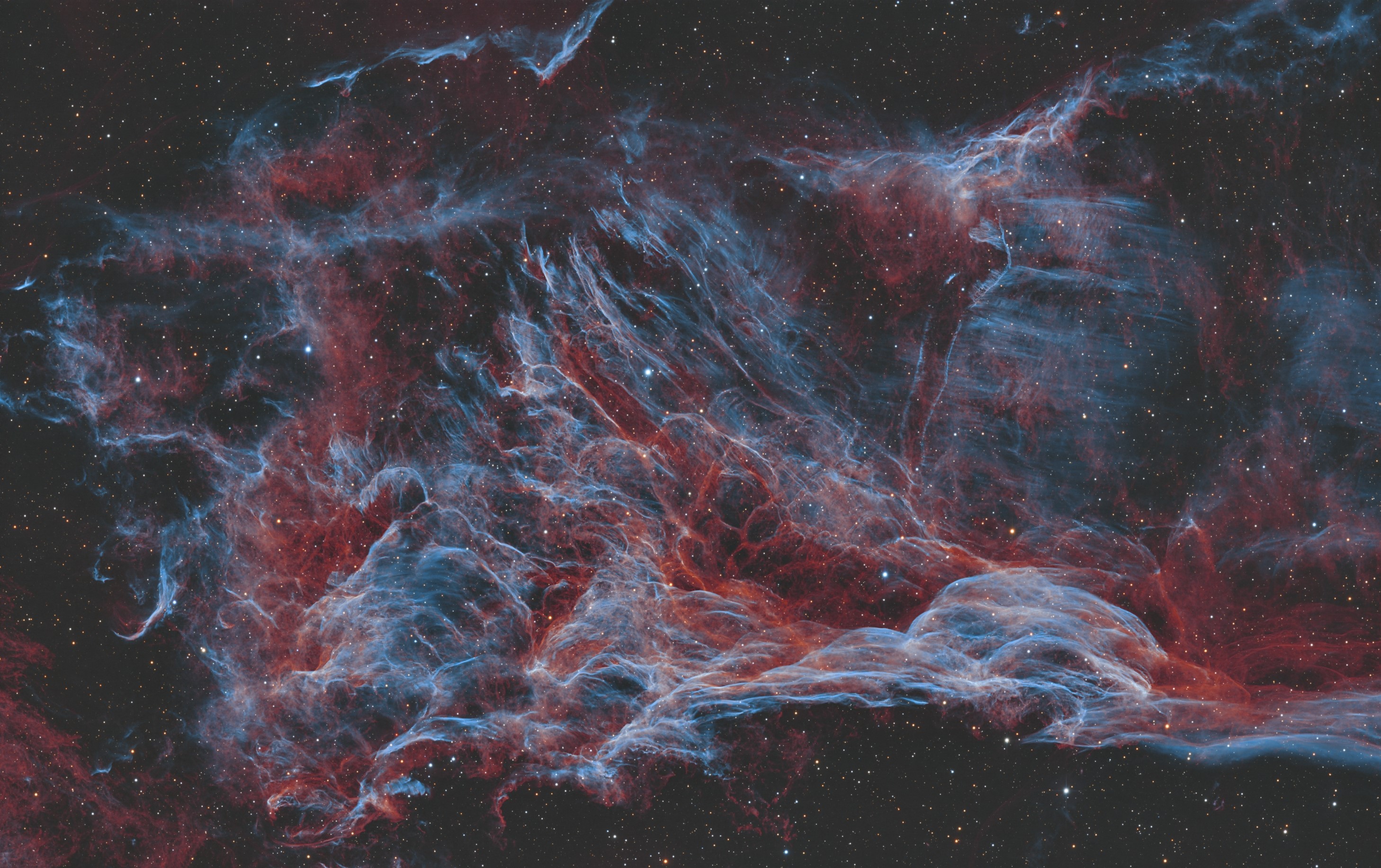
- Incredible images. No need for superlative, just look at this example.
- Not for profit. The subscription goes 100% to the Operational Expenses (telescope hosting and cloud storage). This allow the cost for each team member to be minimum, compared to commercial teams passing the cost of the telescope initial investment and trying to make a profit on top of that.
- C5-100 camera: very large Sony sensor, modern CMOS. Best in class camera. Quality is infinitely better than the low resolution, large pixel snowstorm most teams are getting out of their KAF sensors.
- 50x50mm Chroma filters, 3nm band width for ultra narrow band. Just the best solution to image when some moon is present (which is 50% of the time).
- PlaneWave CDK 14: a very large field of view. The CDKs with an aperture above 14 have a limiting, smaller field of view, while their theorical higher resolution is in practice limited by seeing & guiding. The smaller CDKs lack the resolution and don’t have the image circle to properly illuminate the C5 sensor. The faster scopes (like the Relta-Rho or equivalent) are not compatible with ultra narrow band filters, and are therefore shut down by modest amounts of moonlight. So the CDK14 + C5 +3nm Chroma filters is currently the best system to combine productivity over the entire moon cycle, larger field of view and resolution to the limit of the seeing.
- Free trial: you can download the Crescent dataset (stacked) here to get a preliminary idea of the quality. No strings attached, I do not collect email or ask for anything, just download the zip files. Want to go more in depth? Contact me here, and I will send you the keys to a S3 cloud bucket with over 1 month of scope production, no cost, no string attached.
- What you get:
- all the data from the scope that passes the automatic QC (based on eccentricity, guiding quality, FWMH), in fits format, accessible 24/7 on the cloud. The data is usually synchronized on a daily basis, automatically.
- All the metadata, including guiding logs, images statistics, target plans, acquisition software logs.
- Current Calibration files (Bias, Dark, Flats) pre stack and masters.
- On a regular basis (usually weekly): stacks of the targets.
- Scope status.
- Access to target selection and team discussion forum.
- How are the targets selected? Team members propose targets on the Target Selection forum, and I decide from there, according to conditions, moon, target visibility, and what is suitable for the scope. I try to accommodate everybody’s wish, but there is no guarantee. Projects like 100 tiles mosaic or 200 hours Ha integration will probably not be selected.
- How many team members? The goal is to cover the monthly fee for telescope hosting & cloud storage, and keep the subscription one of the cheapest in the market. This means while the scope is in the US, the team shall remain around 8 team members. If the scope ever goes to Chile, either the fee or the number of team members will increase.
- Lates sales: 6 months after the data has been acquired and distributed to the team, I reserve the right to sale online the stacked only data. Goal is to pay for the scope shipment to Chile at some point.
Imaging goals
The primary goal is to obtain high integration time, high quality data on 2 to 5 DSO targets per month for imaging. We focus on more original targets, rarely imaged with entry level equipment. We will also try to hit every comet brighter than Mag 8 and visible from the observatory. During periods with more than 50% moon, the scope may produce astrometry & photometry datasets (exoplanet transits, asteroid rotation curves, nova decline curves), planetary imaging, satellite imaging, NEO imaging and asteroid discovery if a few team members are motivated.
Data
Each dataset is provided as an S3 Bucket. A team member can either download the data from the bucket to a folder on their computer (with and S3 client, like the free S3-Browser), mount the bucket like a local drive on their computer (for example with free and open source rclone) or process the data from their own EC2 instance.
Get onboard now
Contact me here to join the team.