The one and a half year experience running Moana remotely made me confident I could successfully operate a much more professional set up for top notch results. Given the cost of both the owning and hosting, the data avalanche and the need for complementary talents (for target selection, instrumentation, processing), it also became evident this would have to be a team work.
Telescope automatic update and telemetry, updated every 30mn.
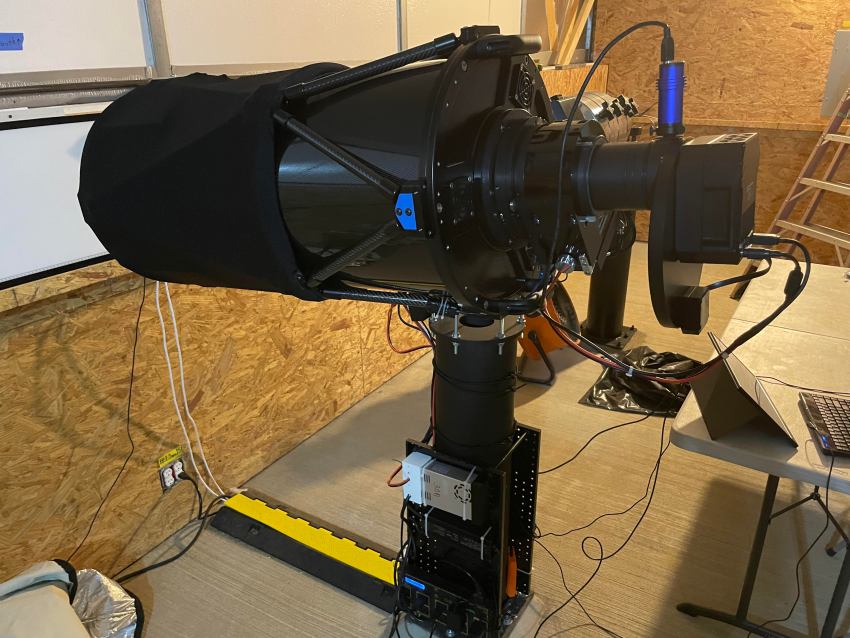
The system, now operational, consists of:
- Mount: AP 1100 GTO. This mounts tracks at 0.3 Arc Second RMS on good nights and has been extensively tested with the payload envisioned for the project. With the CDK, the mass center being close to the equatorial axis, tracking is improved compared to tracking with the lighter but front loaded Newtonian.
- Telescope: Plane Wave CDK 14. This scope has 11 times the aperture of a Tak FSQ 106! Of all the truss Plane Wave telescopes, it is the one with the largest field of view and largest image scale. Optical quality is also incredible. It also has an incredible image circle of 70mm. This allows for true wide field if coupled with a large sensor, despite the rather long focal length (2663mm). The slower speed of f/7.2 makes the system tolerant to imperfections in focus, collimation & tilt on such a big sensor. Don’t take my word for it: download the raw images offered below and see for yourself.
- Camera: Moravian C5-100. A very large (43.86 × 32.90 mm), modern, low noise CMOS sensor, doing justice to the large image circle of the scope. The sensor is the Sony IMX461 sensor, with 11664 x 8750 pixels, 100M per image and 55mm diagonal, and a 16 bits ADC.
- Moravian filter wheel, 7 positions for 50×50 filters.
- Filters: 50x50mm Chroma filter, LRGB and ultra narrow band (Ha, SII, OII) at 3nm.
- Guide camera: QHY 5 III mono plus Moravian OAG (OAG to be upgraded to Mark II.)
- Focuser rotator: Nitecrawler 3.5.
- Connectivity on the scope through Pegasus Power Box V3.
- Acquisition software Nina 3, scheduler and sequencer. Astap for plate solve & PHD 2 for guiding.
- Site: in Central Texas, at a latitude of 31.5 degrees North. The relative proximity of the site to Houston allows frequent trips for any repairs & upgrades. Bortle 3 to 2.
The telescope runs fully automatically, with Nina and the various Python scripts developed during the Moana project.
| Camera | C5A-100M |
| Telescope | Plane Wave CDK 14 |
| CMOS sensor | IMX461 |
| Resolution | 11664 × 8750 pixel |
| Pixel size | 3.76 × 3.76 μm |
| Sensor size | 43.86 × 32.90 mm |
| Sensor Diagonal | 54.83 mm |
| Field of view | 0.98 × 0.74 degree |
| Pixel scale | 0.3 arc second |
| Pixel scale 2×2 binning | 0.6 arc second |
| Aperture | 14 inch (356mm) |
| Focal Length | 2563mm (101 inch) |
| Focal ratio | F/7.2 |
| Filters | Chroma 50x50mm, 3nm bandwidth for NB |

Sample datasets
Crescent Nebula (CDK 14 first light).
Light Frames
After extensive testing i used the following parameters:
- for RGB, Gain 0 to maximize the dynamic of the sensor and take advantage of maximum well capacity, and around 3 minute exposure.
- For Narrow Band, as the Chroma filters are very narrow (3nm) gain is boosted to Gain 2750, so the background noise does not exceed the read noise. 10 to 30mn exposure minimum to provide optimum exposure. 20mn seems like a good compromise on many targets.
Some details about the Telescope installation. It was relatively smooth as far as installs usually go, but there were some surprises and tribulations.
Telescope setup
Here is my complete setup for Phd2, Nina, APCC and ASCOM.
Dust covers
I built a bunch of dust covers for transportation and to have the various holes covered and protected from dust during installation or manipulation.